The 63rd Anniversary

What a wonderful way I had to begin the 63rd anniversary of the crash of Flying Tiger 923!  Fellow survivor Paul Stewart, of Plano, Texas, rang my phone at noon on the anniversary date, Tuesday, September 23, 2025. It certainly set me back with joy!

Paul was one of the 20 or so brother combat paratroopers on board, all headed for Frankfurt, Germany. He is the single survivor I have spoken to in recent years. Probably the youngest of the active duty soldiers on the Flying Tiger at the time of the disaster, Paul says his family is all doing well, are grown and living nearby.  He and his wife have moved into a comfortable senior living center where they can maintain an active retired lifestyle and be close to family.

Paul spent most of his working career as a lineman for the local electric system. A young 17 year old on 9/23/62, he is now 81. I was 21 at the time I am now 84. We are both happy to be here to celebrate another memorial year. We remember with love and high regards all of those on that fatal flight and those involved in so many ways.

The crash of Flying Tiger 923 in that stormy, frigid North Atlantic is far from forgotten by the remaining 48 survivors and their families and friends as well as:

. . . the dozens of crew members and hundreds of their colleagues of the rescue ship, Swiss registered MS Celerina, a freighter loaded with wheat headed from Canada to Antwerp, Belgium, who provided food, clothing and shelter for the three storm-tossed days at sea to the survivors, all pulled from the lone, overturned life raft;

. . .  and the crew and all of their support personnel of the US Airforce plane that intercepted the SOS calls from the failing Tiger and diverted its course from Scotland to New York to find, track and identify its location from above for the benefit of the rescue ship;

. . . and the hundreds, if not thousands of Canadian sailors of the aircraft carrier Bonaventure and four escort destroyers that were diverted to meet the rescue scene to provide medical and material assistance wherever possible;

. . . and the many hundreds of emergency rescue workers mobilized in the Republic of Ireland at the Cork and Shannon Airports, and the light keepers of the Galley Head lighthouse that served as point of coordination for rescue helicopters that took the most seriously injured from the Celerina to the Cork City airport and Mercy Hospital.  By then, the Celerina was only some eight miles from the Irish coast and could not get any closer due to the unreliable outcropping of rocks in the shallower waters;

. . . and the lists of those involved goes on and on.

Unfortunately, there was no memorial update last year. As the author and editor of this Memorial Site, I must confess that I have not lost interest in the project . I have done very little to update these pages in recent years and none whatever in the past year. My latent case of PTSD rose up and slowed me down with deep feelings of sadness, which has made it difficult to write or talk about it. I am happy I was able to put so much into this memorial as I have, nearly 140 articles in total. I plan to make some significant updates, no matter how few readers may share memories of this event.

This is truly a memorial site for an event that was minimally publicized in the autumn of 1962. This was likely due to the heightening tensions over the threatening “Cuban Missile Crisis.” Do you remember that one? The Russians were sending missiles, some of which were believed to be carrying war-heads, some nuclear war-heads, to the island nation of Cuba. They were planned to be aimed at its closest neighbor, the USA.

I was unaware of this event until long later because I was preoccupied with being a combat parachute trooper dedicated to learning how to defend his nation and went for months as many others did with not paying attention to the news. The bottom line for us involved in the crash, is that most of the news was suppressed. Active combat troopers were not to be transported on the military transport system, even though there were only about 20 aboard, because it might reveal that strike force troops had been reduced during the quieter years following the Berlin Wall Crisis. The result was there was never a memorial created at the time for this event.

The demise of Flying Tiger 923 was a tragedy of tremendous proportions, especially to those directly involved, but not nearly so much as the tragedies of the Vietnam War that followed.

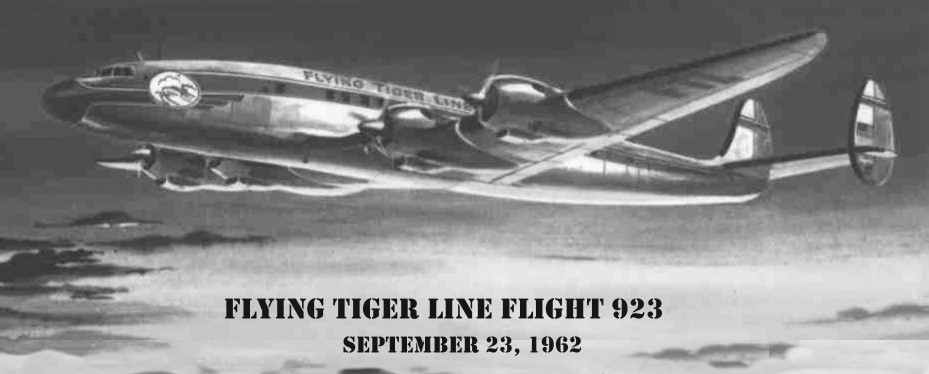
We are honored that you should be reading this and any of the 114 stories linked to the drop-down menu immediately below the picture of our very own tiger above. God bless everyone during this historic 63rd Anniversary Year. Thank you.

And following is a contribution by our friend, Garry Ahern, of Dublin, Ireland, who was there as a member of the first Emergency Fire and Rescue Team of the then-recently opened Cork Airport. He first penned this poem as part of an adult education night school program:

Ode to Big Bird (Flying Tiger 923)

A Memorial Poem for the “Big Bird” Flying Tiger Flight 923

by Garret Ahern, Dublin, Ireland

“Big Bird”

Out from New jersey,

Big Bird spreading wings,

Trundling east-ward, in

War-cold nineteen-sixty-two.

Three-score and ten-

And more aboard,

Service by the

Rhine in mind.

Far beneath lies rolling

Equinoctial ocean,

Unfriendly to the stricken

Super-Constellation.

Big Bird descending,

Inevitable ditching,

Frantic prayers implore –

Then impact, devastation.

Plucked from the inverted,

Overcrowded, life-raft,

The lucky greet new

Friends and shipmates.

In time, diverted,

The good ship “Celerina”

Nears its rendezvous.

Green fields plain to see.

By Galley Head, the

Helicopter’s chatter

Stampedes a flock of sheep.

Away west, wave-battered

Big Bird settles,

Low in the briny deep.

© 2012, Garry Ahern
Posted in Uncategorized | 7 Comments

It’s already 61 years…

Saturday, September 23, 2023 is the 61st Anniversary of the little known tragedy of Flying Tiger Flight 923, ditching some 500 miles off the west coast of Ireland. It was at night in the middle of the frigid, raging North Atlantic Ocean. Seventy six souls were on board, men, women and children. Twenty eight perished while 48 miraculously survived after a six-hour wind and wave-tossed raft ride and joyous connection with the Swiss freighter, the Celerina. The date was September 23, 1962, just as the “cold war” was heating up with the “Cuban Missile Crisis.”

There was very little news of the event. Frankly, there seemed to be a whole lot of silence, considering the vast volumes of publicity given most airplane crashes of the time. Even the families of the combat paratroopers who died that night received little more than a telegram notifying them of the death of their sons. There were no commemorations or memorials.

After living with the quiet tone of the event for nearly 50 years, this web site was created to give some recognition to those who lived and died and those responsible for rescue operations. I was motivated to get involved because I realized what a major factor this Flying Tiger crash played in my life. I not only survived, but circumstances led me to my lifelong career, my marriage to a green-eyed Irish cowgirl, the adoption of Ireland as my second country of residence, and the ownership of a lovely, historic farm house in a very beautiful part of Ireland. This is all true, but yet I knew so little about what had driven me all of those 50 years.

My father gave me a head start by saving anything he could find about the crash, although there was very little to find. Most of it was in the form of small news clips, minus the names of most sources and dates.

I worked with the little I had and, quickly in the process, I discovered there were really hundreds of people involved, including 1,500 crew members on one Canadian aircraft carrier that delivered several recovered bodies to Shannon, Ireland, and four fellows who comprised the first emergency rescue team at the new Cork, Ireland airport.

This web site was started with that small bit of seed information and has expanded to include more than 112 stories and has garnered more than 126,000 public views since its beginning. Word of mouth has led to the discovery of more information and more stories.

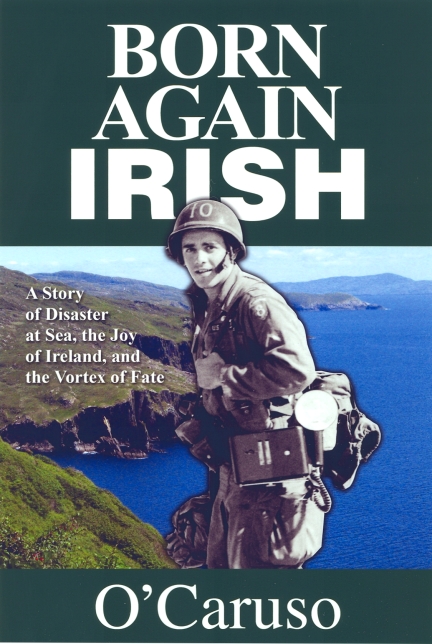
By the 50th anniversary, other things were happening to revive the memory of Flying Tiger 923. I had just recently completed my book in 2007, Born Again Irish. The book quickly sold out its first printing of 2,000 copies and as books are traditionally passed around, more people came up with more memories.

Born Again Irish, The book
Book Cover

Far more people in Ireland were aware of the crash than in the U.S. I made friends with the lighthouse keeper of the Galley Head light house near Clonakilty, which was the rendezvous point for ambulances and helicopters during the evacuation of the first group of injured passengers from the rescue ship to hospitals in Cork City some 30 miles away. I was lucky enough to be a part of that group of 17 although my injuries in my mind were minor. The helicopter flight over Galley Head was the point at which I fell in love with Ireland.

As with most conversations, one thing leads to another and an Irish fisherman said you ought to do your own memorial. And that got the ball rolling. I arranged to have a memorial engraved and organized a public ceremony on the day of the 50th anniversary. With less than two weeks of preparation, we were able to arouse nearly 100 people to attend, including the Swiss Ambassador to Ireland and a representative of the Swiss rescue ship, who had been on the Celerina during the rescue operations.

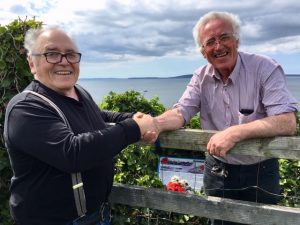
Fred Caruso and Mike Flahive

At the exact same time as our proceedings at Galley Head, Mike Flahive and his family arranged a ceremony on his farm on the Bowmar Cliffs. The farm overlooks the Shannon River estuary near the Shannon Airport. He is keeping his beautiful memorial open to the public.

In Switzerland, two feature reporters from two of the four stations of the Swiss National Public Radio were broadcasting their on-the-scene reports. Both came to Ireland to see first-hand the good work and fondness everyone felt for the Swiss rescue ship, the Celerina, and its crew of more than 30 who participated in the three-day recovery operation.

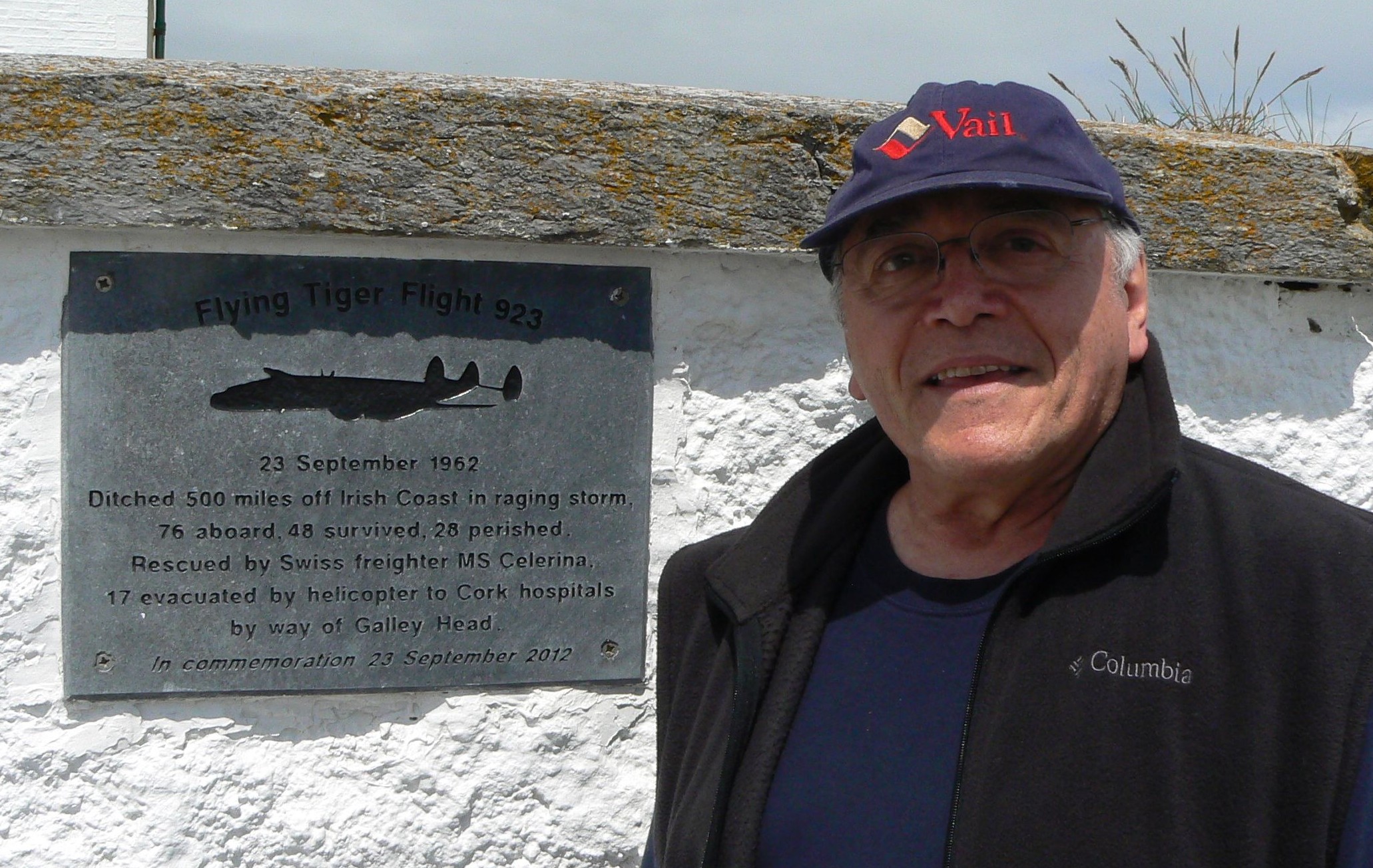
Above is the first memorial to the Flying Tiger 923 affixed to the entry of Galley Head Light House, which was the flyover point for rescue helicopters and the first land seen by 17 of the more seriously injured of the survivors. Most of these injured were suffering from serious burns caused by the combination of aviation fuel and salt water soaked into wool uniforms and rubbed into the skin over the six hour trip in the life raft. The memorial was placed at Galley Head on September 23, 2012.

Flying Tiger 923

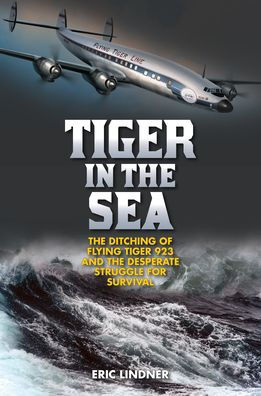
During this period of time, a seasoned author by the name of Eric Lindner was beginning his very serious search into the demise of Flying Tiger 923. His wife, Ellen, is the daughter of the pilot, Captain John Murray, who at the time of the crash was a young child. She and the entire Murray familyand always wanted to know more about the crash and wondered why so little was known about it. Lindner made use of the information in this web site in the development of his very comprehensive and interesting book. Anyone with even the slightest interest in this crash should get a copy of Tiger in the Sea. It’s a great book.

Incidentally, since the publication of this book, which is available in hardbound, audio and kindle formats, the number of public views of this web site has been increasing significantly.

And now for a small confession from me to all readers and to those who may not read but know me: for more than 50 years I have lived with the compelling desire to say thank you to the crew of the airplane that changed its direction and got on our tail and followed us to splash down. I will forever remember my six hours confined in that crowded rubber raft, seeing an airplane circling above us and the thrill and wave of renewed hope and confidence every time a marking flare was dropped. I tried in all sincerity to say thank you in my book, only to have a young lawyer from New York City phone me in no uncertain terms that I had not only acknowledged the wrong crew, but had the wrong airline. His father was the crew leader and the plane was a U.S. Air Force transport carrier going in the opposite direction. Embarrassing is an understatement. You can read about that aircraft and crew and that feat of heroism in this website.

And thank you again and again for all of the hundreds of heroes who made it possible for us to celebrate this year and all of those anniversaries in the past. These heartfelt thanks include the lovely nurses at Mercy Hospital in Cork, five of whom came to the party to celebrate the release of my book, Born Again Irish, on anniversary 45. Back in the day, in 1962, they were five of the most beautiful red haired, blue eyed lassies dressed in white nurse’s uniforms treating the survivors. Many years later, they were still beautiful, even dressed in the traditional black robes of catholic nuns.

What different and interesting roads we all take on this journey of life. No two of us can be the same. We all do the best we can at whatever time we are doing it and we keep moving on.

And one more important thank you to our hero, Captain John Murray, for his skill and judgement that dark night in 1962 that saved so many lives.

Posted in Uncategorized | Tagged , | 19 Comments

The Unexpected Sometimes Happens

Every tragedy has its unusual or quirky circumstances. Some are very, very sad. Others are almost humorous. Most would be nearly impossible to imagine in advance.

Art Gilbreth 2012
Art Gilbreth 2012

Art Gilbreth Felt the Flight Number May Spell Trouble

Art Gilbreth was an Army private, a new paratrooper, who before boarding noticed the relationship between the Flight Number “923” and the flight date of September 23 (9/23). After the crash he made a resolution: he will never again board a plane when the flight number is the same as the date. And to this date, as far as we know, he has stayed true to his resolution.

The Insurance Dilemma

A few days after rescue, while the injured troops attempted to heal in their hospital beds, insurance adjusters were busy trying make settlements to help cover losses. They figured that, in their minds, $200 was more than enough compensation, to cover lost uniforms and so forth. Several felt very strongly that those soldiers could have purchased “flight insurance” before the flight, couldn’t they? Wouldn’t they? If they had, they wouldn’t need a large insurance settlement to make things good. It was their fault for not buying a little insurance at the airport, wouldn’t it be?

Gilbreth Made His Choice

In real life it didn’t always happen that way. Standing before two vending machines at the McGuire Air Force Base, just before departure, Gilbreth remembers:

“After not being able to go to a bank between leaving Jump School at Fort Benning, Georgia, and boarding Flight #923 in Newark, New Jersey, I stood between the two vending machines. One offered flight insurance for as little as 25 cents and the other offered cigarettes for 25 cents. I reached into my pocket and found a quarter, the only change I had. In fact it was the only money I had, having not being able to go to a bank. Guess which one I chose?”

. . . . . . . . .

Raul Acevedo 2012
Raul Acevedo 2012

Raul Acevedo had injuries in his legs, right ankle, right hip, neck and back. He was one of the new paratroopers evacuated from the rescue ship at Galley Head and flown to Cork City for basic hospital treatment. He was later taken to an Air Force Hospital in England where he spent several weeks of intensive treatment. Eventually, he was discharged and sent on to his assignment in Germany. You can see his full story by clicking here.

Raul Acevedo Has Difficulty Getting Attention

His parents were not in the United States at the time of the crash, but were instead at their home in Mexico. They did not even know that he was drafted into the Army. It was a shock to them to hear of the Flying Tiger ditching and his hospitalization through a friend who sent them a story that appeared in the LA Times front page. His father passed out with the news when he was able to contact them by phone. He felt he had to see them to prove that he was still in good condition.

Following the Chain of Command

He took the traditional channels to seek permission for getting a special leave, but felt he was getting no where. Finally, he had an idea, to write to the commander in chief, John F. Kennedy. (The story mentioned above details the very careful and effective process.)

He sent his certified letter off and had to wait. A few months went by and an officer from higher command came looking for him. He said “”you have special orders and money to go to Mexico for 31 days.”

His home base officers were surprised and somewhat alarmed, since all he had to do was ask them. When he reminded them of the number of times he had asked, they understood that he was genuinely concerned, he had tried the chain of command several times and really needed to report to his family.

. . . . . . . .

Carol Ann Gould
Carol Ann on the Celerina

Flight Attendant Finds a Real Challenge with Last Flight

This was to be Carol Gould Hansen’s last flight as a stewardess. In fact, she hadn’t even planned on the trip at all. She took the flight as a back-up for a colleague. She couldn’t say no to a friend in need. Carol had planned to stay at home to work on her upcoming wedding.

Carol kept her cool throughout the entire preparation for ditching, offering kind and comforting words for everyone. She had never experienced a water landing before, but she was a professional and knew the exercise. She assured everyone that they would make it safely.

Even after the extremely violent crash, she was immediately helpful to every survivor within her reach. She treated several of the injured on the rocking and pitching raft, even though no first aid kit was available. The lone kit intended for use was totally out of reach, zipped in a safety pocket under the upside down raft.

Bringing Calm With Singing

Carol led a group in song, especially after one of the injured women began to scream upon seeing the lights of the approaching rescue ship and thinking it was a Russian military ship. She was convinced the Russians would hold off far enough away to wait for everyone to die or was there to take them all as cold war prisoners to frozen Siberia.

Carol, who was the only surviving stewardess, lifted many spirits that night, on the lone rubber life raft and later on the rescue ship Celerina. Upon returning home to New Jersey, she gave up flying as a stewardess and became a tour guide, emphasizing world wide travel. She formed her own company and to this day the firm carries her married name, “Hansen Tours and Travel.”

. . . . . . . .

Caruso as Army Journalist

Tragedy Leads to Unexpected Career Change

Newly minted combat paratrooper, Fred Caruso, son of a second generation Italian immigrant family in New York, gained unexpected notoriety by writing a very detailed description of the plane crash, beginning with the fire in engine number three which burst into flame right out of his window. His day was going down hill fast and the fire was the last straw. His writing began soon after making it to safety on the Celerina, and continued until the evacuation at Galley Head. That writing, in the form of a letter to his parents in New York resulted in a full front page of a widely read British newspaper, the Daily Mail.

That twist of fate soon led to his finding an opportunity as an Army journalist, which ultimately led to his final assignment at the Stars and Stripes News in Darmstadt, the same place as Peter Foley worked at the time of the crash.

The journalism experience led him into a lifelong career. It was the rescue and evacuation to Ireland that led him on a lifelong quest to become an Irishman himself.

The experience at the Stars and Stripes inspired hime to finish his last two years of college at the University of Montana School of Journalism at Missoula, Montana. This led to meeting his eventual bride, an Irish lass who was also pursuing a journalism degree. (Montana has an extremely high number of Irish immigrants, mainly due to the copper mines at Butte).

Marriage into a second generation Irish family led to the pursuit of Irish roots, which led to both of them becoming full Irish citizens. They soon purchased an Irish farmhouse not far from the point of rescue at Galley Head near Cork City. The two of them began exploring leads on the little known crash of the Flying Tiger, all of which led to the 50th anniversary memorial at Galley Head.

. . . . . . . . .

Sometimes the truth is stranger than fiction. Every story on this site is unique and nearly all would defy the human ability to “dream it up.”

Posted in Uncategorized | Tagged | 5 Comments

Dedicated to Captain John Murray

Our Anniversary #58 is dedicated to 

Captain John D. Murray, our pilot, a true hero .  .  .

Captain John Murray held 78 lives in the palms of his hands. The weather was horrible. It was dark and the winds were nearly gale force. His Flying Tiger was limping on only one engine. The other three were dead,

It had to be a “white knuckle” flight. He held tight to the controls as he searched the darkness for a suitable stretch of sea to lay the big bird down at its final resting place.

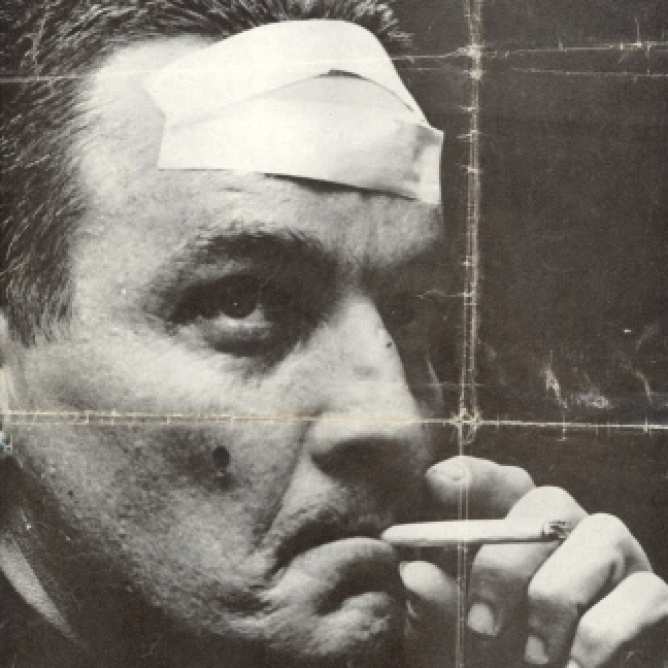
Captain John Murray with head wound upon crash

captmurray324x425


The controls were shaking violently. He grasped all the more tightly. No stretch of water seemed safe enough. Even with almost no power left in its single remaining engine, the heavy aircraft was moving too fast to skip to a soft landing. The ocean troughs and valleys were getting shorter but steeper and more violent. He concentrated and prayed for an inspiration. There had to be a place where he could put down without disintegrating into a twist of metal and human bodies.

He was determined to find it. Read his challenge:

*     *     *     *     *     *     *     *    

(Ed. Note: This article was previously published on November 11, 2011, soon after the launching of our memorial blog. Since then we have had 104,053 public views from around the world. Early readers may have forgotten details of Captain Murray’s story. New readers may have missed it completely. He is the man who held our lives, and his own life, in his hands. Had it not been for Captain Murray, it is unlikely you would be reading this story today.)

Captain John D. Murray, 44, of Oyster Bay, Long Island, knew 76 lives were at stake as he slowly brought down the Super Constellation in preparation for ditching in the howling winds and raging waves of the cold north Atlantic.

He faced a dilemma as he searched his way through the darkness: he could follow the recommended ditching strategy of putting the plane down between the troughs, or take advantage of the 50-knot winds at sea level, which would cut his landing speed in half. His challenge was to get the plane down, either way, in the dark, in a gale, with 20 foot waves and with no power left for a second attempt if he didn’t get it right the first time.

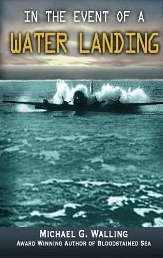
The photo on the cover of the book to the left depicts the ideal water landing. Reports of the ditching say the aircraft sank somewhere between two minutes and ten minutes after the splash down, probably closer to the ten minute side.

Captain Murray hit his head on the control panel and was bleeding to the extent that he could hardly see. He made his way out after retrieving a flashlight from the cockpit. He was most likely the last man out and was very late getting to the raft that was filled far beyond capacity. He was pulled in and he sat on the lap of a serviceman.

Evidently the crew was aware of a possible rescue ship, but thought it might be 12 hours off. An aircraft had been following the Flying Tiger right up to its contact with the waves. That aircraft, a US Air Force plane on its way from Prescott, Scotland to Nova Scotia, had diverted in response to the SOS. Because it had been following so close, it knew the position of the raft and soon began dropping flares to mark the location.

The lone life raft that was to hold all survivors had accidently inflated upside-down. That caused the emergency lights along the upper rim of the raft to glow deep into the black waters, making them totally useless. The emergency kit that contained first aid materials and a badly needed flashlight was out of reach as well. Those items were zipped in the raft’s emergency pouch which was now facing down into the water.

The raft drifted at a rapid clip for nearly six hours, covering about 22 miles in that time. Waves that seemed to glow in the dark splashed over the passengers, delivering a frigid chill every time.

Finally a rescue ship came into sight, the Celerina, a Swiss freighter. Due to the size of the waves, the recovery had to be handled with care. Rope ladders were thrown out to the raft and people began to cling to them. The crew pulled the ladders up with passengers clinging to them, taking them into safety. Captain Murray was again one of the last to get off the raft. When he had nearly reached the top, the ship pitched and he fell off, sinking into the dark waters alongside of the raft. A trooper grabbed his life vest and pulled him back into the raft. He made it into the ship on his second try.Murray at CAB Hearing

There have been a number of news stories about Captain Murray’s role in the recovery. Some questioned his method of ditching. Ultimately, his choice resulted in the survival of 48.

The Saturday Evening Post ran a photo feature that included a sketching of the jam-packed raft being tossed among the waves. Fortunately for the survivors, Captain Murray was a flying pro! Had he not been, the outcome might have been far more disastrous.

According the Civil Aeronautics Board report adopted September 10, 1963, Captain Murray had a total of 17,500 flying hours, of which 4,300 were in the L-1049 type aircraft. His last FAA first class physical examination was passed on June 16, 1962 (limitation – reading glasses). He had flown 247.4 hours (172.9 in L-1049s) in the last 90 days; 72.6 hours (41.2 in L-1049s) in the past 30 days; and had 33 hours of rest prior to the flight. He knew flying and he knew the L-1049.

Months after the crash, Captain Murray relocated his family from the states to Shannon, Ireland, where he continued to work for the Flying Tiger Line. Tragically, he died some six years later in a scuba diving accident off the coast of Australia.

Captain Murray is our hero.

Posted in Uncategorized | 9 Comments

Air Force Journalist Reaches Out to the World

Many Thousands Read of Ditching

By Teresa Foley (special to this Memorial Website)

At the time of the Flying Tiger ditching in the North Atlantic, my father Peter Foley was in the Air Force and had reached the rank of Senior Master Sergeant. He was assigned to the the Stars and Stripes newspaper.  He was returning home on Flying Tiger 923 to his family in Germany after having completed a special reporting assignment in the United States.

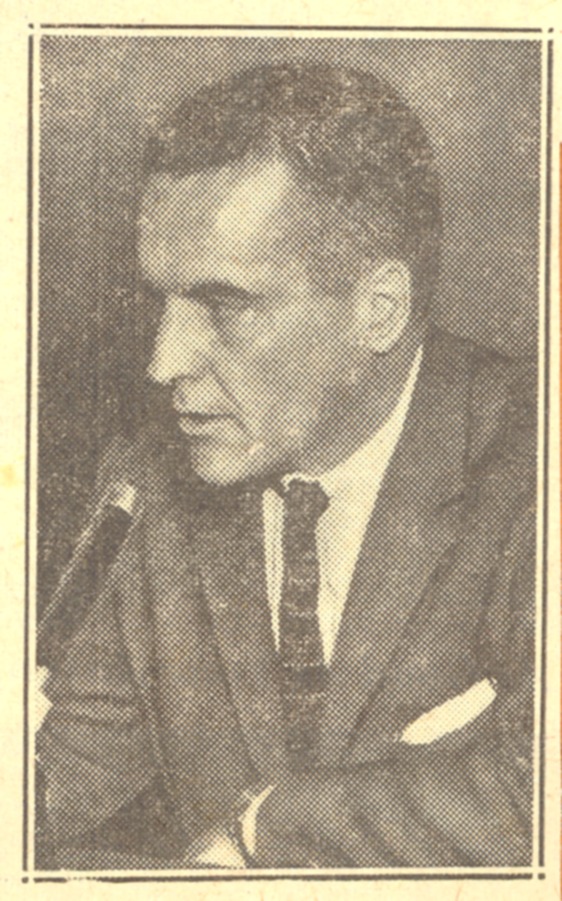
Peter Foley

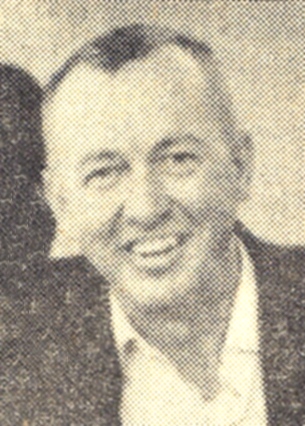
Peter Foley only days after the ditching and rescue.

He managed to survive the disaster and was able tell the world about it. It was a shocking, violent, and grueling experience that lasted for days for everyone involved. As a news reporter, he bounced back nearly immediately to fulfill his mission.

As Peter Foley’s daughter, I got to know him as a man with a long and colorful career and a loving dedicated family man. I am using this web site as a means of telling his story.

*   *   *   *   *

Pete Foley was a cheerful and vibrant man who loved life and had strong survival instincts. Those instincts were severely tested a number of times.

As a very young man with a love of excitement, he joined the Merchant Marines soon after getting out of school in the late 1930s. After a brief stint of service, Peter returned to his hometown of Butte, Montana and went to work in the copper mines that dominated the city and its surroundings.

He was a “motorman” and it was his responsibility to drive the ore cars in and out of the vast maize of dangerous tunnels being mined.  He tells us that one day, a tunnel caved in, trapping many men inside. It was the “worst and the hottest” of tunnels in the mine. He escaped the disaster. Luckily, the trapped miners found an airway to crawl through until they reached a spot where rescuers could drop metal cages and pull them out.

From Merchant Marines to Air Force

Pete later enlisted in the US Army Air Forces. During World War II, he worked as an airplane mechanic.  He wasn’t in combat but again escaped death in 1945.

At the age of 28, he was on a cargo plane that got lost and ran low on fuel.  According to Pete, “I was on leave, going to visit somewhere.  I happened to pick the wrong plane.”

Everyone on board was able to parachute out of the plane before it crashed.  Pete described his free-fall through clouds and with birds, as a thrill – not a fright, and an experience that ended too soon.  His parachute landing was smooth and something he “thoroughly enjoyed”.

He served in Korea from May 1950 through June 1953. His decorations included the Bronze Star, the Republic of Korea Presidential Unit Citation, the Korean Service Medal, the United Nations Service Medal and the Air Force Commendation Medal.

After Korea, Pete attended and was a graduate of the Armed Forces Information School and the Strategic Air Command NCO Academy.

In 1951, Pete married Mary Wallace of Helena, Montana, in Yakahoma, Japan. Like many military families, the Foleys had duty stations throughout the United States and the world.

In 1962, after completing an assignment in Nevada for the Stars and Stripes, the military newspaper in Europe, he boarded Flying Tiger Flight 923 to return home to his pregnant wife and five children in Darmstadt, Germany.

Engine Troubles

As problems began to unfold, a fellow passenger asked him if one of the four engines quit running, how would the plane fare.  Pete’s response was to  “stop worrying, this plane could fly forever.”

Then the second engine failed. After the third engine failed he, and everyone else, knew the plane was in trouble, but there was no time to panic. Following is how Pete described his experience:

“Another soldier and I yanked out the escape hatch next to us and dropped into the water.  I tried to get my life vest inflated, but I couldn’t.  I was carried by waves toward the rear of the plane.  It had sunk so deep that my head was level with the top of the fuselage.  I decided not to waste any more time on the life jacket and began to swim.  The waves buried me a couple of times.  People were all around me.  There were cries of ‘Where are the boats?’ But no rafts were in sight.  It was dark and windy, and giant waves were pitching us around.

“I thought I felt a wing under my feet.  It was the tail.  Then a wave slammed me against the antenna.  It’s strung from the top of the forward cabin to the top of the tail.  I threw my left arm over it.  I scraped the arm and it hurt.  I thought it was a good time to rest for a moment.  I kept telling myself not to panic.  Once you panic, you’ve had it.

“After a few moments I realized it was calm.  I kept waiting for a wave to break over me.  Then I realized the plane was sinking and I was under water,  I let go and swam slowly to the surface.

“I was tired, dead tired.  How easy it would be to quit fighting the sea and get it all over with.  It would be so easy to die.  Just stop fighting for half a minute. I shook my head, realizing this was a hell of a way to go.  I also knew how mad Mary would be if I didn’t return home.

“Then I spotted a raft.  It was just a shadow and it seemed a long way off.  I managed to swim over to it and held on to a rope.  I got my head up far enough to see inside, but I couldn’t get in.  I asked for help.  Someone said he didn’t have the strength.  Then he grabbed my arms and somebody else pulled me in by the seat of my pants.”

The Rescue Ship Arrives

The Celerina arrived when “it was early morning, but still dark. . . A sailor pulled me onto the deck.  I said I was all right, then fell on my face.  Somebody caught me and helped me into the crew’s mess, where I was given warm clothes and a jolt of whiskey. I couldn’t pick it up. A sailor poured it down my throat.  It felt wonderful.”

While on the Celerina, Pete did what he could to help, all-the-while thinking, “How do I get this story back?” to his boss at the Stars and Stripes. He found a way to radio stories each day. “I don’t  think I even thought about dying.  Time passed so quickly, it seemed like the next thing I knew I was waving at Mary.  All I knew was I was back where I belonged.”

Whenever Pete talked about this plane crash, he would sadly mention the children; he never saw the girls after the plane hit the water.  His family had to fly from Germany to New York when he was transferred to Travis AFB in 1963. After his family boarded the plane, Pete went to airmen in the plane and made them promise to help his kids in case anything happened.  He then introduced each airman to the child he was responsible for. Mary said she was sure most of the people thought he was a crazy old sergeant.

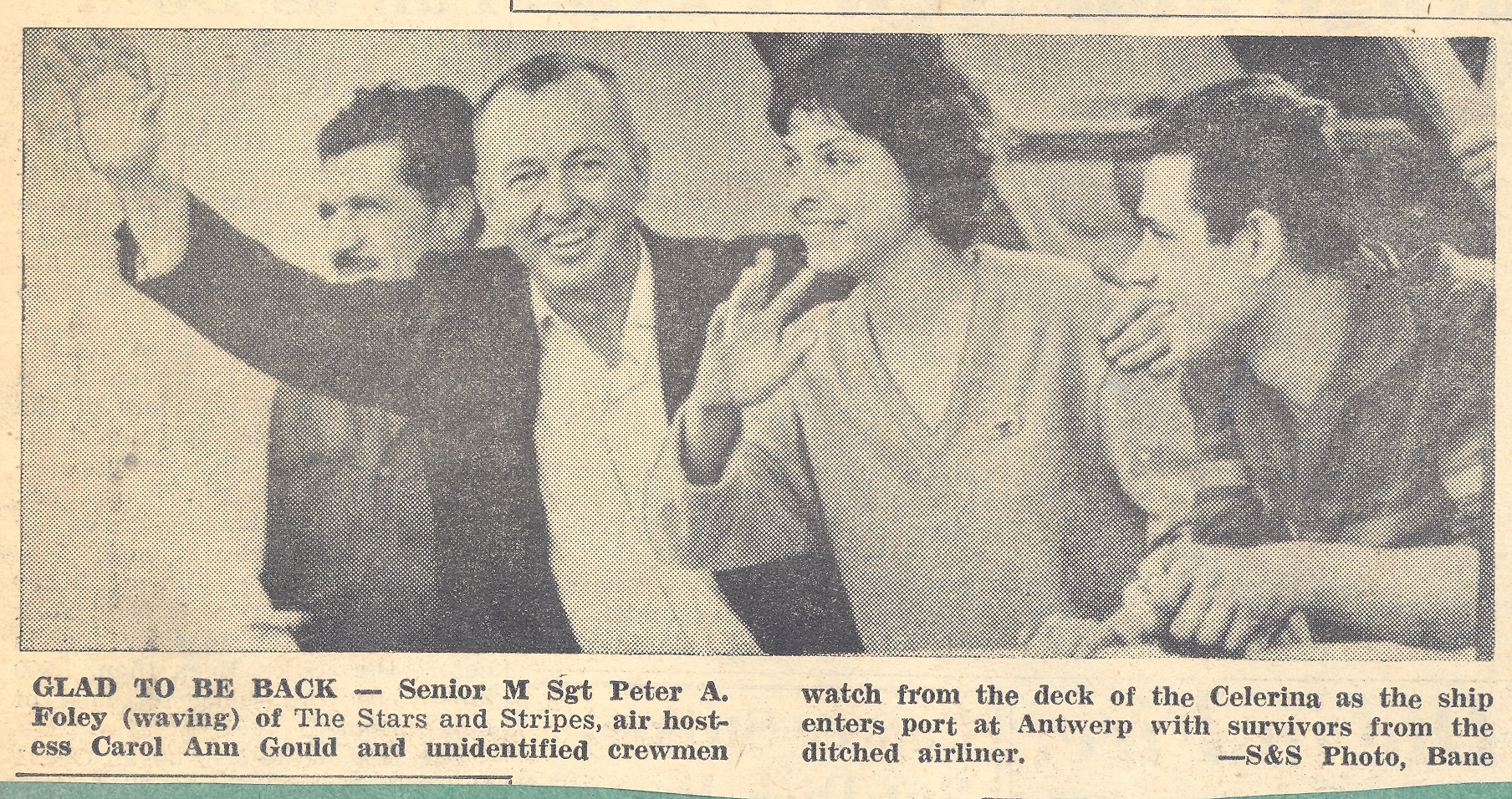
Peter Foley waving to onlookers at Antwerp, Belgium.

Peter Foley, 2nd from the left, waving to the gathering crowd as the rescue settles into port at Antwerp, Belgium. To his right is a fellow ditching survivor, air hostess Carol Ann Gould. To both edges of the photo are unidentified Celerina crew members who took part in the rescue of the lone life raft.

Pete retired from the Air Force in 1965 and moved his family to Citrus Heights, California (a suburb of Sacramento). He was a smart person, loyal to family and friends, an enthusiastic supporter of his family activities, an adventurer, a teacher, a hard worker and a wonderful example of how to get a job done. He and his family were very active in community and school activities. They loved to travel, camp, boat, water and snow ski, ocean dive and always enjoyed a good party.

A Breeder of Lady Bugs

In 1981, Pete and Mary bought a struggling business that supplies beneficial insects for pest control and turned it into the largest supplier of ladybugs in the US.  In 2001, Pete and Mary celebrated their 50th anniversary.  Later that year, Pete lost his battle with melanoma and died in November.

People often say they would die for someone they love. Pete’s character, however, was to focus his strength and energy on living for the people he loved and helping them to have a good life.  Pete Foley lived a very good life.

*     *     *     *     *

Editors note:

This story was written by Pete’s daughter, Teresa. She discovered this web site and soon thereafter discovered her father’s military career keepsake box. That gave her the material and incentive to submit this story. Pete’s original story was published in an October 1962 edition of the Saturday Evening Post.

 In 1964 due in part to notoriety I had obtained from a very dramatic story I had written about FT923 and with very good fortune, I was assigned to the Stars and Stripes news desk in Darmstadt. I was one of only four military staffers. The rest of the newspaper staff was civilian.  At that point, Peter Foley rose from “role model” to “hero” in my mind and remained that way though out my working career. I never had any personal contact with him or his family. I only had news clippings of his work. I had no way of ever knowing him as a compete person. His daughter, Teresa, has given me that opportunity. I am honored to be the person to pass that story to you. — Fred Caruso

Posted in Journalist, passengers | 6 Comments

National Magazine Shows Agony in Raft

Packed like sardines.

51 people packed in a raft for 25.

Air Force Journalist and Ditching Survivor Peter Foley did a lot of writing about the horrors of the ditching and joys of survival. One of  his stories with perhaps the most impact appeared in the Saturday Evening Post magazine in October of 1962. Included with that story was an artist rendition of the single, flooded and overcrowded life raft. The picture tells the story quite accurately. (Packed like sardines.)


Posted in Uncategorized | 1 Comment

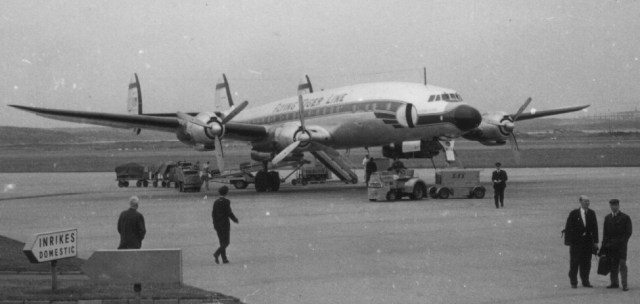
The Actual Flying Tiger #923

Chartered for an education and orientation tour.

Photo above is the actual Flying Tiger Flight 923 aircraft that was ditched in the North Atlantic on September 23, 1962. The photo was taken in June of 1961 by Ragnar Domstadt, who was junior in engineering at the Chalmers Technical University at Gothenberg, Sweden. The Super Constellation with the registration number N6923C was sitting on the tarmac of the old Gothenberg Torslanda airport. Ragnar had arranged for the chartering of the aircraft to fly his engineering class to and from the US for an education and orientation tour. He was surprised to see the aircraft involved in a deadly crash at sea within 15 months of the trip he had arranged.

Posted in Uncategorized | 8 Comments

Fifty seven years and counting . . . . .

FLASH FACTS on the demise of Flying Tiger 923

September 23, 1962

Nearly fifty eight years after the crash of Flying Tiger 923, it is still astonishing to see how little was known by the survivors of the event that very nearly took their lives or as in too many cases took the lives of loved ones. No one had an opportunity to see all of the local news stories. Actually there were very few stories outside of England and Ireland and virtually none in the United States after the initial incident.

The editor of this site considers the untimely demise of Flying Tiger 923 to be unusual in many ways. The facts surrounding the event give some indication of  the unusual nature of the incident:

* A total of 76 men, woman and children were on board the aircraft – 48 lived, 28 died. Three of those died in the life raft or during the rescue. On this particular flight some 20 freshly trained combat paratroopers had been added to the manifest at the last minute to speed their assignment to strategic locations in Germany during a heating up of the Cold War.

* Of eight crew members (included in the 76 total above) only three survived. They were the captain, navigator and one stewardess.

* The crash was initiated as an intentional, controlled water landing (a ditching) of a crippled air liner. It occurred some 500 miles off the west coast of Ireland at night during a raging storm. Impact was roughly at the latitude west of Galway, Ireland, and approximately in the same area as the final destruction of the Spanish Armada of 1588 .

* The aircraft was NOT a military plane. It was a civilian plane chartered by the Military Air Transport System (MATS). It was intended to serve the needs of military officers and higher ranking non-commissioned officers and their families of all branches of service

* The aircraft broke apart on impact, losing its left wing, tearing a hole in the left side of the plane and sinking within 7 to 12 minutes.

* Only ONE 25-man rubber life raft out of the five total that were supposed to be on board was usable, and had to hold all 51 who reached it.  Three persons died on the raft before reaching the safety of the rescue ship.

* Tragically the ONE usable life raft inflated UPSIDE DOWN, putting the safety lights and the emergency medical supplies underneath, making them unreachable in the pitch-black water.

* Only ONE flashlight, snatched from the cockpit of the aircraft by the captain, was available for emergency signaling during that six-hour drift.

* In the six hours from impact to rescue, gale-force winds drove the overloaded raft 22 miles through the raging waves and swells.

* The wind-whipped, white-capped waves ranged from 10 to 12 feet high and ocean swells were reported as being up to 35 feet high.

* The first aircraft to locate the crash site, within minutes of impact, was a US Air Force C-119. That aircraft circled the area of the survivors for nearly six hours, dropping spotting flares, until it ran dangerously low on fuel.

* The rescue ship was the Swiss freighter, MS Celerina. It was 492 feet long, had a crew of 35, and was loaded with wheat grain from Canada headed toward Belgium. The ship’s crew gave survivors their sleeping rooms and clothing and as much comfort as possible.

* The storm that ravaged the survivors in the lone life raft, raged on for three more days, making a major evacuation of injured by helicopter nearly impossible.

* When the storm cleared, 17 of the most seriously injured were helicoptered off the ship at the rendezvous location near Galley Head lighthouse, and taken to Cork, Ireland hospitals.

* Two days later, the remaining survivors disembarked from the ship at Antwerp, Belgium.

* The aircraft was known as the “Queen of the Atlantic,” for its being one of the first aircraft to be used successfully to transport commercial passengers over the Atlantic. It was a four-engine Lockheed Super Constellation 1049H. It had the registration number of N6923C.

* The last reported position of the aircraft, only minutes before the ditching (according to the Civil Aeronautics Board “Aircraft Accident Report” released on September 13, 1963), was reported as being 54 degrees 10 seconds north latitude, and 25 degrees 30 seconds west longitude.  The time of the message was 21;42 (9:42 p.m.) on September 23, 1962 (9/23/62).

There are of course hundreds of details and situations not listed here. The stories found in this memorial site include many of them. (Find more than 120 stories using the menu above. Mouse over the subjects to see what is recorded in this site.)

Regarding the availability of little or no information, it is worth noting that the 20 or so combat Army paratroopers who survived were sent directly to their assignments with no medical or family leave or briefings on what really transpired. None had written orders or instructions relating to their unexpected change of plans. Other passengers, virtually all related to the military, went on their way, knowing only what they experienced. Even the handful of those who were selected to attend and participate in the Civil Aeronautics Board hearing held in New York City, nearly one year after the crash, learned little beyond the bureaucratic, technical details that focused on the performance of the aircraft and crew. There was more to know.

{Compiled, written and posted by Fred Caruso}

Posted in flight crew, new combat troopers, passengers, Uncategorized | Leave a comment

Bromore Cliffs Memorial

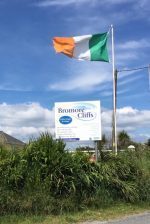
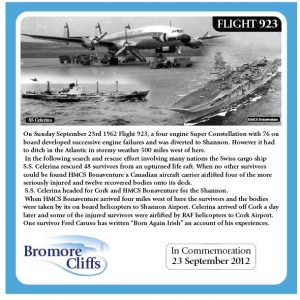
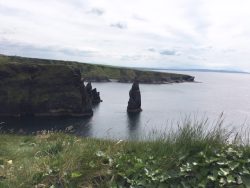
It was a sunny day at Bromore Cliffs at Ballybunion, Ireland. This is the site of one of the two known memorials for the crash of the Flying Tiger 923, which occurred some 500 west of that point, on September 23, 1962. It was at night, during a vicious North Atlantic storm. Seventy six men, women and children were on board. Approximately 20 of the passengers were newly graduated combat paratroopers headed for their first assignments at bases in western Germany. Forty eight persons survived disaster. Twenty eight died in the ravages of the sea.

Bromore Cliffs Memorial Plaque

Bromore Cliffs Memorial Plaque

Local Bromore Cliffs community leader Mike Flahive created the memorial, totally on his own and on his own property where his cattle graze at the steep edges of the cliffs. The memorial garden is open to the public and attracts dozens of visitors daily, many of whom come from around the world to play golf at the famous Ballybunion golf course.

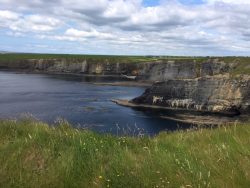
Views from the Cliffs


Flahive was inspired to dig into the details of the crash when at the age of 11, he looked out his bedroom window at the edge of the cliffs to see the giant Canadian aircraft carrier, Bonaventure, stopped no more than a football field distance away at the mouth of the Shannon River estuary. The ship was bringing in some of the dead and injured from the crash. The crash was widely publicized in Ireland and England while being virtually unnoticed by the United States news media.

Seen shaking hands are at left, Fred Caruso, one of the survivors who was evacuated by helicopter at Galley Head to Mercy Hospital in Cork City, Ireland, To the right is monument creator and memorial garden benefactor, Mike Flahive. The two were featured in a TV documentary entitled “Wild Atlantic Way” produced by well-known and popular RTE broadcaster, John Creedon.

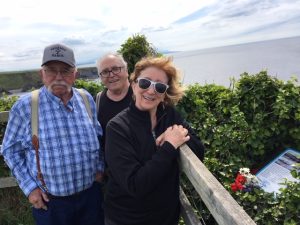
Three visitors shown in the photo are Cowboy Hugh Broadus a cattle rancher from Colstrip, Montana; Fred Caruso of Eagle, Colorado and Glengarriff, County Cork, Ireland, and Margaret Ellen Caruso, his wife and sister of the Cowboy. The three were treated to a night in the cozy family cottage on the cliffs, from which Flahive saw the Canadian Aircraft Carrier on September 25, 1962. The Bromore Memorial site commemorates several shipwrecks and air crashes along the “Wild Atlantic Way” and features an original World War II observation sentry post. The site is open to the public daily.

Posted in Uncategorized | Leave a comment

Flying Tiger Flight 923 Makes it to the World-wide Encyclopedia Wikipedia

It was always something of a mystery and a disappointment to me (the author of this article), NOT to find such an important historical event listed in Wikipedia, the free, universal, world-wide Encyclopedia. The North America version of Wikipedia (in English) contains a number of entries about the Flying Tiger Line and articles on historic events of the air line, such as its crashes.

So I am very happy to report now that details of the tragic Flight 923 have finally made it to the pages of Wikipedia. The good news is that it is there for the world to see more easily, but the bad news is that it is currently only viewable in the German version in the German language!

The article is detailed and accurate as you would expect in an encyclopedia listing. Errors in spelling and grammar are probably due to non-human electronic translations. Two of the major contributors to the article are friends and published contributors to this Flying Tiger 923 Memorial web-blog. Peter W. Frey is a special-interest, investigative reporter and radio announcer with the German region Swiss Public Radio network. Frey flew to Ireland in 2012 to interview me and an important rescuer, Pierre Andre Raymond. Another contributor is Georg Stockli. He was the radio operator on the MS Celerina the night of the crash.

Read about both men on this website by clicking these links: Peter Frey and Georg Stockli.

Our thanks to Karen Eldred-Steffan for bringing this article to our attention. Karen lives in Germany, which is why she was able to connect with the article over the internet. In Germany the search engines automatically default to the German version of Wikipedia.*

Karen is the daughter of then retired Capt. Robert Eldred and Mrs. Edna Eldred, both of whom were passengers on the fateful night of September 23, 1962. Capt. Eldred survived to tell the story, but his wife tragically perished in the crash. Karen was 17 at the time. You can read Captain Eldred’s story on this site by clicking the link on his name.

Karen has been sending items for use in this site during the past year, much of which had been collected and saved by her father who has since passed away. We very much appreciate her commitment to this memorial.

Here is a link to the German Wikipedia entry:

https://de.wikipedia.org/w/index.php?title=Flying-Tiger-lIine-Flug_923&oldid=168502501

Most search engines have a translation function built-in, but if the article pops up in German, it can be translated by any of a number of on-line translation programs. We will attempt during the coming year to get the article listed in the English master edition of Wikipedia.

*     *    *     *    *     *

* [The German Wikipedia edition] Founded in March 2001, it is the second-oldest, after the English Wikipedia, and with 2,251,582 articles, at present (2017) the fourth-largest edition of Wikipedia by number of articles, behind the English Wikipedia and the heavy bot-generated Swedish Wikipedia[1] and Cebuano Wikipedia.[2][3][4] It has the second-largest number of edits and over 260,000 disambiguation pages.[5] On 7 November 2011, it became the second edition of Wikipedia, after the English edition, to exceed 100 million page edits. [Note: This paragraph was taken directly from the German Wikipedia explanation of itself.]

Posted in Other Gems, passengers, Uncategorized | Tagged , , , , | 10 Comments